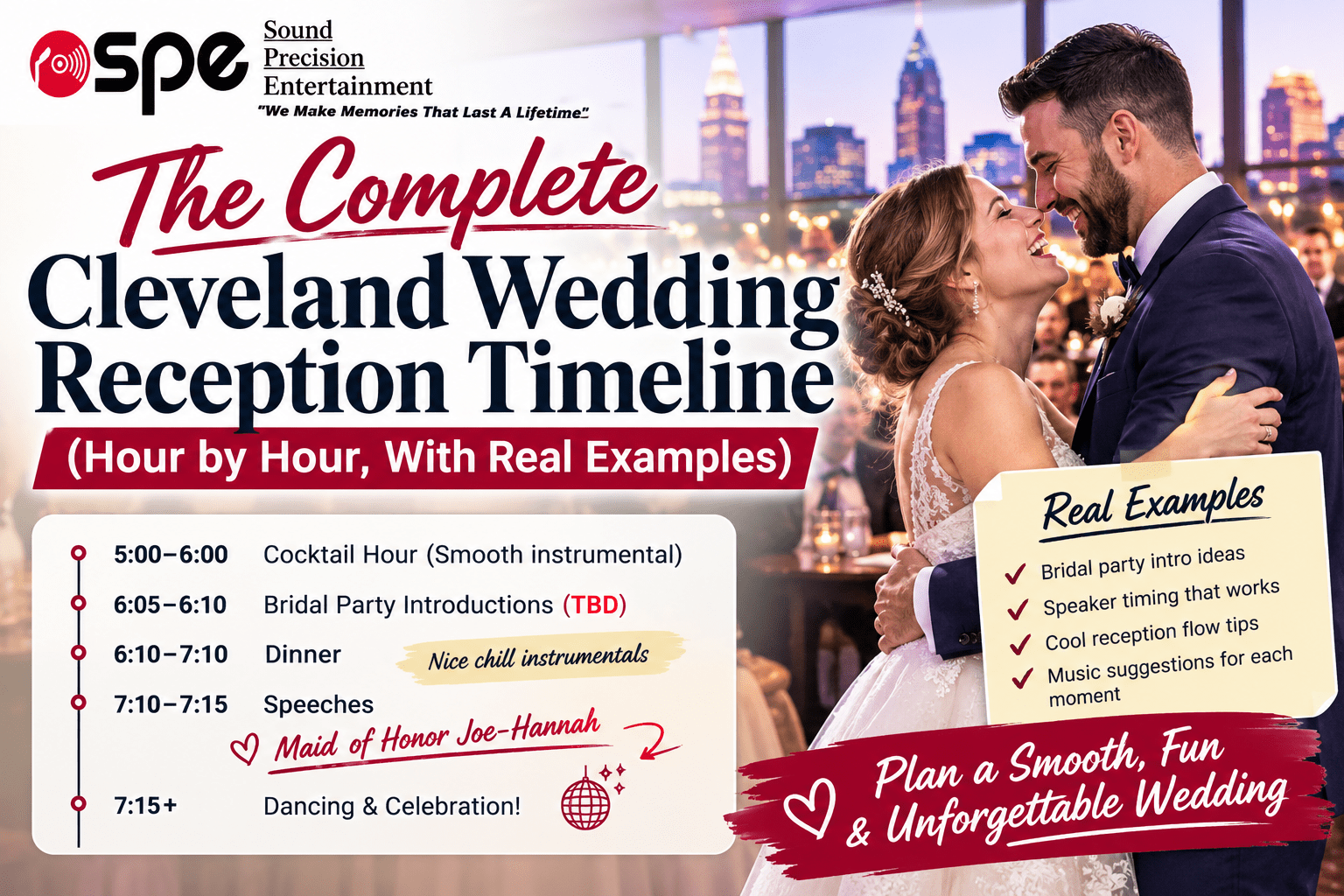
The Complete Cleveland Wedding Reception Timeline (Hour by Hour, With Real Examples)
A standard Cleveland wedding reception runs about five hours, from 5:00 PM to 10:00 or 11:00 PM. Cocktail hour takes the first hour, grand entrance and first dance happen around 6:00, dinner and toasts run from roughly 6:15 to 7:45, parent dances and cake cutting follow, and open dancing starts by 8:15 at the latest. The single most important number in that whole sequence is the one where dancing begins — every minute you push it past 8:30 costs you guests.
That’s the short version. Below is the long one: the full hour-by-hour breakdown, the three timeline shapes that actually happen in Northeast Ohio, and the specific places we watch timelines fall apart most weekends.
We’ve been running receptions across Cleveland and Northeast Ohio for nearly two decades. This is the timeline we build from — and the reasoning behind each block, so you can adapt it to your day instead of copying it blindly.
The master reception timeline
This assumes a 5:00 PM reception start, an 11:00 PM end, and a plated or buffet dinner for roughly 150 guests. It’s the most common shape we see.
| Time | What’s happening | Who’s running it |
|---|---|---|
| 4:30 PM | Vendors set, sound checked, music on before the first guest walks in | DJ |
| 5:00 PM | Cocktail hour opens — guests arrive, bar opens, background music | DJ |
| 5:45 PM | Guests invited to find seats | Emcee |
| 6:00 PM | Grand entrance — wedding party, then the couple | Emcee |
| 6:05 PM | First dance | DJ / Emcee |
| 6:10 PM | Welcome toast, blessing, dinner released | Emcee |
| 6:15 PM | Dinner service begins | Catering |
| 7:00 PM | Toasts — best man, maid of honor, parents | Emcee |
| 7:30 PM | Dinner service complete, tables cleared | Catering |
| 7:40 PM | Parent dances | DJ |
| 7:50 PM | Cake cutting | Emcee |
| 8:00 PM | Dance floor opens | DJ |
| 9:00 PM | Bouquet / garter, or anniversary dance, if you’re doing them | Emcee |
| 9:15 PM | Peak dance set | DJ |
| 10:15 PM | Late-night snack, if you have one | Catering |
| 10:50 PM | Last dance | DJ |
| 11:00 PM | Hard stop, guest send-off | — |
Copy that as your starting point. Then adjust it using the sections below, because almost nobody’s day is actually the standard shape.
Which timeline shape is yours?
There are three, and Cleveland skews heavily toward the first one.
Shape 1: Church ceremony, separate reception venue (the Cleveland default)
This is the most common wedding structure in Northeast Ohio, and it’s the one national timeline templates handle worst.
Here’s why. Cleveland is a heavily Catholic city, and most Catholic parishes schedule Saturday nuptial Masses in the late morning or early afternoon — often between 1:00 and 3:00 PM — because a vigil Mass usually occupies 4:00 PM or later. Meanwhile, almost every couple wants an evening reception.
The result is the Catholic gap: a two-to-four-hour window between the end of the ceremony and the start of cocktail hour.
The gap isn’t a problem to be solved so much as a structure to be planned around. What we tell couples:
- Use it for photos. This is the single best argument for the gap. A two-hour window is a gift to your photographer, and it means you’re not missing your own cocktail hour.
- Give guests somewhere to go. A nearby bar, a hospitality room, a hotel lobby with a cash bar. Put it on the website. Guests who have a plan don’t experience the gap as dead time.
- Budget the drive honestly. Cleveland traffic on a Saturday afternoon is forgiving, but a parish on the east side to a reception venue in Lorain County is a real 45–60 minutes, and shuttle loading adds 15 more.
- Don’t let the gap eat your reception. If the gap pushes your reception start to 6:30, your dancing starts at 9:30, and you’re now fighting for energy in a room that’s been going since 1:00 PM.
Shape 2: Ceremony and reception at the same venue
Cleaner, and increasingly common at venues like Standing Rock, Grand Pacific Junction, and most of the newer downtown and barn venues.
The thing to plan for here is the flip — if your ceremony and reception happen in the same room, the venue needs 45–60 minutes to reset it while guests are at cocktail hour. That’s not padding; it’s a hard operational requirement. Your cocktail hour cannot be 30 minutes.
Sample: 4:30 ceremony → 5:00 cocktail hour → 6:00 grand entrance. Everything downstream runs on the master timeline above.
Shape 3: Outdoor ceremony
Same as Shape 2, with two additions: a rain plan with a stated decision deadline (usually four hours before ceremony), and sound considerations that most couples don’t think about until it’s too late. Wind off Lake Erie and through the Chagrin Valley will eat your vows if the ceremony audio isn’t set up for it.
When should the dance floor actually open?
By 8:00 PM. 8:30 at the absolute latest.
This is the number we defend hardest in planning calls, and it’s the one couples push back on most, because it feels arbitrary. It isn’t.
Here’s the arithmetic. Your guests arrived at a church at 1:00 PM. They’ve been dressed up, sitting, standing, driving, and drinking for seven hours by the time dinner ends. They have a finite amount of energy left, and it is draining whether or not you’re using it.
At 8:00 PM, that room is warm, fed, a couple of drinks in, and ready. At 9:00 PM, a meaningful chunk of it has mentally checked out — grandparents are thinking about the drive home, parents with young kids are calculating the babysitter, and the college friends have wandered to the bar. You can get them back. It’s just much harder, and you’ve burned an hour of a dance floor you paid for.
The most common way this goes wrong isn’t one big delay. It’s four small ones that stack:
| Small delay | Cost |
|---|---|
| Cocktail hour runs 15 min long waiting on photos | 15 min |
| Grand entrance waits on a wedding party member | 10 min |
| Dinner service runs behind the caterer’s estimate | 15 min |
| Toasts run long — four speakers instead of three | 15 min |
That’s 55 minutes. An 8:00 dance floor just became 8:55, and nobody made a single bad decision along the way.
How do you build buffers that actually hold?
You add the time before it disappears. Four buffers, in order:
- +10 to 15 minutes after cocktail hour, before grand entrance. Photos always run long. Always.
- +15 minutes on whatever your caterer estimates for dinner service. Caterers quote their best case. Ask specifically: “how long for 150 guests, plated, two entrée choices?” — then add fifteen.
- A hard cap on toasts. Three speakers, five minutes each, communicated in advance and in writing. Unlimited toasts is how a 20-minute block becomes 50.
- A buffer after toasts, before dancing. Ten minutes for the room to clear plates and reset. Opening the floor while servers are still working the tables never lands.
That’s roughly 50 minutes of buffer built into a five-hour reception. It sounds like a lot. It is exactly enough.
What order should the formalities go in?
There’s more flexibility here than most couples realize, and the ordering has real consequences for energy.
The standard order — grand entrance, first dance, welcome, dinner, toasts, parent dances, cake, open dancing — works well and we run it most weekends.
The rule that matters more than the order: never stack more than three or four consecutive seated activities. If your guests go entrance → first dance → welcome toast → blessing → dinner → best man toast → maid of honor toast → parent toast → cake cutting, they’ve been sitting and watching for two straight hours. The room goes flat, and a flat room is much harder to lift than a warm one.
Ways to break it up:
- Sprinkle toasts through dinner rather than clustering them. One between courses keeps attention live.
- Move parent dances earlier, right after the first dance, so they’re part of the opening moment instead of another seated block before dancing.
- Cut the cake during dinner, quietly, and skip the announcement entirely if you don’t want the ceremony of it.
- Open the floor immediately after the first dance for one song, then go to dinner. It’s unconventional, it works, and it tells the room early that this is a party.
One thing worth eliminating: the long, announced cake cutting. It stops the room, it takes eight minutes, and almost nobody watches. Cut it early and quietly.
How does the timeline change with guest count?
Guest count moves dinner more than anything else. Everything else scales less than you’d think.
| Guests | Cocktail hour | Dinner service | Grand entrance to dance floor |
|---|---|---|---|
| Under 100 | 60 min | 45–60 min | ~1 hr 45 min |
| 100–175 | 60 min | 60–75 min | ~2 hrs |
| 175–250 | 60–75 min | 75–90 min | ~2 hrs 15 min |
| 250+ | 75 min | 90–120 min | ~2 hrs 30 min |
Buffet vs. plated matters less than people expect — a well-run buffet with two lines can beat a plated dinner for 200. What matters is how many servers are working and how many entrée choices you offered. Ask your caterer directly.
What venue constraints should you check before you build anything?
Build the timeline around these, not the other way around. Ask your venue:
- What time is the hard stop? Many Cleveland venues end at 11:00 PM, some at midnight. Some outdoor and residential-adjacent venues are earlier because of local noise ordinances.
- What time can vendors load in? If your DJ can’t get in until 4:00 for a 5:00 start, that’s tight but workable. If it’s 4:30, that’s a conversation.
- Is there a room flip? How long does it take?
- When does the bar close? Usually 30 minutes before the hard stop, which affects where you place the last dance.
- Is there an overtime option, and what does it cost? Decide in advance, not at 10:45 PM.
- Are there sound restrictions? Decibel limits, outdoor cutoff times, or restrictions during specific hours.
Get these in writing before you finalize anything. A timeline built without them is a draft.
Frequently asked questions
How long should a wedding reception be? Four to five hours is standard. Five hours gives you a full cocktail hour, an unhurried dinner, and roughly two and a half hours of dancing. Four hours works but requires tight formalities and a dance floor that opens by 7:45.
How long should cocktail hour be? A full 60 minutes. Cut it to 45 only if the couple isn’t taking photos during it. If there’s a room flip, plan 60–75 minutes.
What time should the grand entrance be? Immediately at the end of cocktail hour, once guests are seated — typically 6:00 PM for a 5:00 PM reception. Don’t announce it early; give your emcee five minutes to get the room seated first.
Should the first dance be right after the grand entrance? Usually yes. Guests are already standing and watching, attention is at its peak, and it doesn’t require re-gathering the room later. The alternative — first dance right before open dancing — works too, and transitions well into the dance set.
How many toasts should we have? Three is right. Four is the ceiling. Five minutes each, communicated in advance. Tell each speaker the limit in writing, and have your emcee reinforce it warmly on the mic.
When should we do parent dances? Either directly after the first dance, or right before open dancing. Right before dancing is more traditional; directly after the first dance keeps the seated blocks shorter. Both work.
What time should the last dance be? Ten minutes before the hard stop. If your venue ends at 11:00, the last song starts at 10:50. That gives the room a real ending instead of the music stopping mid-set.
Do we need a wedding planner to build the timeline? No, but you need someone who has run one before. A good DJ and emcee build timelines constantly and coordinate them with your venue and caterer. If you have a planner, they lead and we execute alongside them.
What’s the biggest timeline mistake couples make? Underestimating dinner and letting the dance floor open late. Nearly every flat reception we’ve seen traces back to those two.
Download the template
We built a fill-in-the-blank version of this timeline with the buffers already in place. [Download the Cleveland Wedding Reception Timeline Template →]
A note on who actually runs this
A timeline on paper is a document. A timeline in a room is a person.
The reason we care this much about the schedule is that our DJs also emcee — which means the same person tracking the music is watching the caterer, catching the maid of honor before she starts a fourth toast, and deciding in real time whether to hold the cake cutting because the room is finally warm. That’s not a scheduling function. It’s a judgment call, made forty or fifty times over the course of a night.
If you’re planning a wedding in Cleveland or anywhere in Northeast Ohio and you want a team that treats the timeline as seriously as the playlist, we’d love to talk.